Your game,
your code,
with in real time.io
From card games to co-op to competitive shooters. Write plain TypeScript with the stack you already use and deploy it to servers that cost nothing when empty.
Multiplayer hosting on demand.
Every room is a micro server that runs your code. It starts when players join and sleeps when players leave. Infinite scaling and free when no one is playing.
One command deploy
Deploy bundles your room, updating your server code and optionally your static assets too. You get a URL players can join. Roll back to any version with the same command.
How deploys workRooms start when players join
Rooms sleep when empty, wake in 66 ms and cost nothing while they sleep. Event based games sleep between every player action.
Lulls and spikes handled for you
Don't let your game crash right when it goes viral and don't overpay when demand is low. Empty games cost nothing and your game can spike to thousands of players instantly.
Simple pricing
No CCUs. Pay for the time your rooms are active on the CPU you need and not for player count. Efficient code gets rewarded.
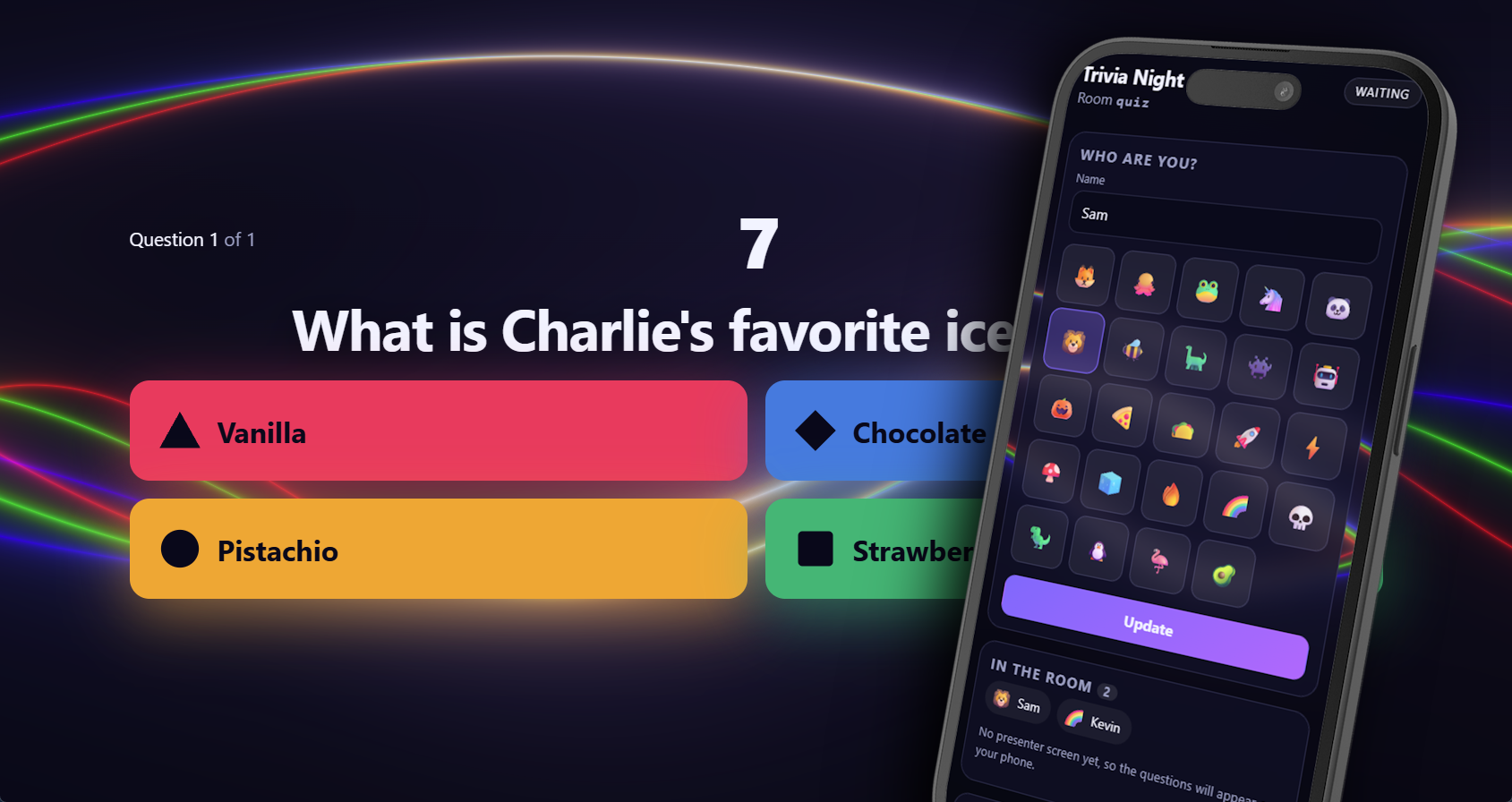
Trivia Night
Phones are the controllers, the TV is the host. Different roles see different state. Answers come in as typed RPCs the server scores, and the room hibernates between rounds, so an idle lobby costs almost nothing.
Try it How it's builtChoose the level of control you need.
One size does not fit all. Depending on your game or app you choose how much authority to leave up to the clients.
Relay
For games and apps with full client trust joinRoom() syncs shared state and relays messages between clients. No server code needed.
Stateful Relay
At no extra cost relay rooms can maintain state on the server, players send updates and changes sync to everyone. Re-join and late-join, more players supported.
Ownership
Co-op games and limited trust. Each player owns their own objects. Their changes sync to everyone, with optional server-side validation to clamp or reject impossible actions.
Fully authoritative
For competitive games that can't allow cheaters. Zero trust. The server runs the competitive logic so players can only do what the rules allow.
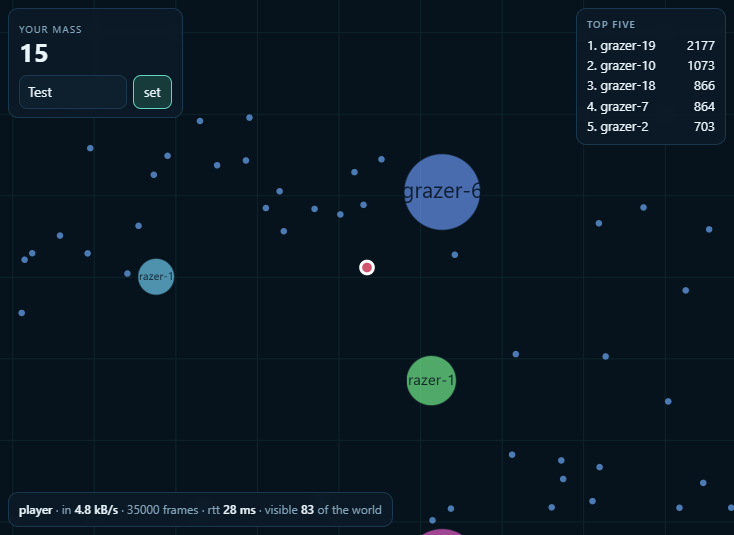
Plankton
Hundreds of players in one arena with bots. The server owns the state and each client only receives what's near it to keep bandwidth flat no matter how crowded it gets.
How it's builtWrite multiplayer like the rest of your code.
Same language, same types, one project. Call functions on the server right from your client code.
Call server functions
Typed RPCs, defined once and implemented on the side that answers. Deal a hand, resolve a turn. The logic that has to be fair lives on the server.
RPCs// client: call it like a local function const { cards } = await room.call.deal({ count: 2 }); // server: the server deals from one deck deal(state, { count }, ctx) { return { cards: state.shoe.draw(count) }; }
Own your objects
onJoin hands each player ownership of its entity. The client then writes to what it owns like local state; the server syncs it to everyone and can veto any change.
Ownership// server: onJoin gives each player ownership onJoin(state, ctx) { state.players.add(ctx.clientId, { x: 0, y: 0 }, { owner: ctx.clientId }); } // client: move what you own, like local state const me = room.state.players[room.me]; me.x += dx;
Run it on the server
The client sends a shot as a typed RPC. The server rewinds to the tick the shooter was looking at and checks the hit there, so a shot that landed on their screen lands on the server. Cheating never touches authoritative state.
Lag compensation// client: fire along your aim room.call.fire({ dir }); // server: rewind to the tick the shooter saw fire(state, { dir }, ctx) { const at = ctx.clientTick ?? ctx.tick; const eye = eyeOf(ctx.clientId); return ctx.room.rewind(at, (past) => { const ray = new Ray(eye, dir); const hit = past.rapier.world.castRay(ray, 100, true); const who = hit && past.rapier.who(hit.collider); if (who) state.players.get(who.id).hp -= 25; }); }
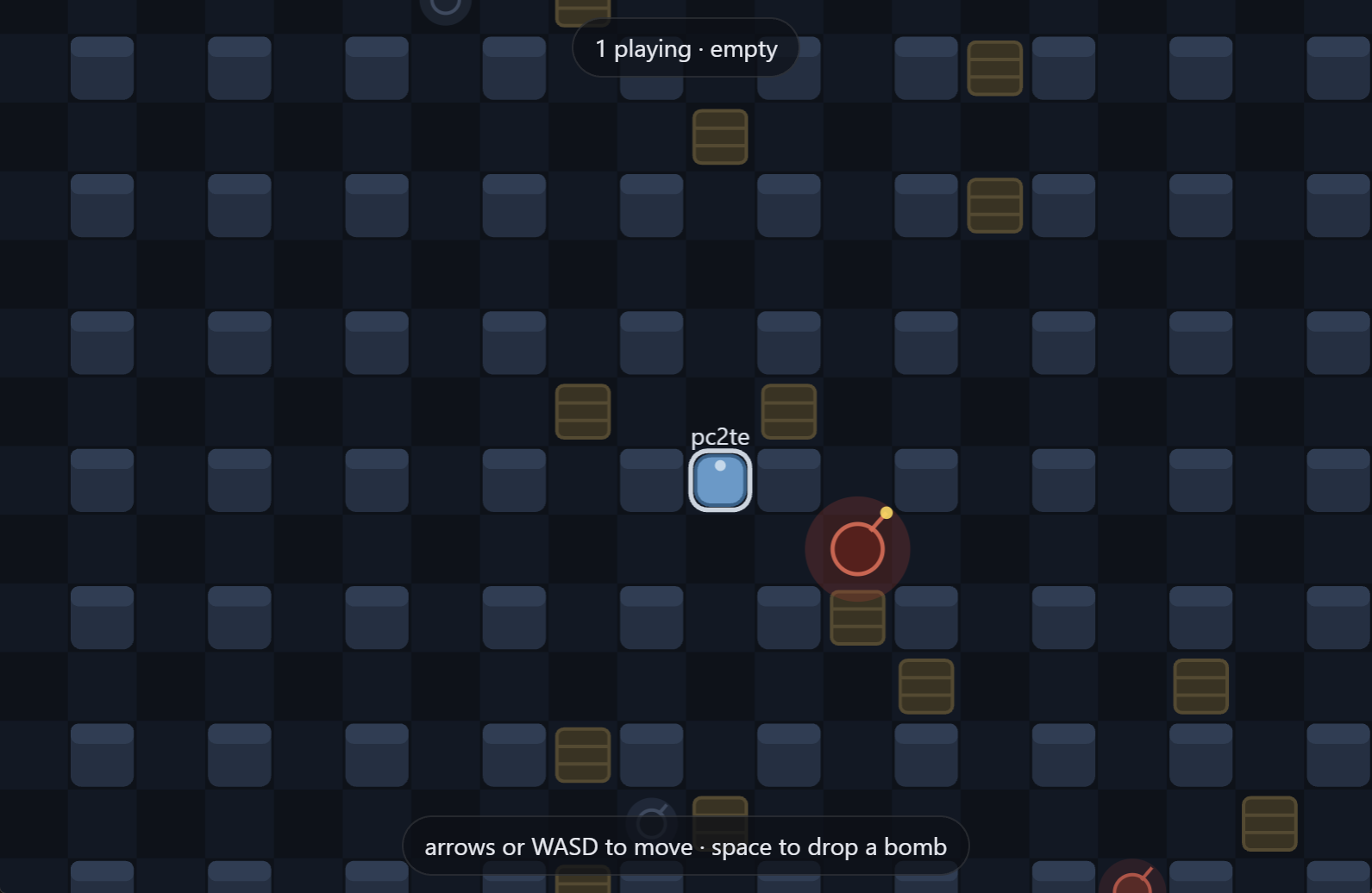
Bombs
Players place and avoid bombs over relay but using irt.io's stateful relay the server maintains state so late joiners and reconnections are handled seamlessly.
How it's builtAnd the hard parts, handled.
Client side prediction
Client inputs applied instantly and local physics simulation.
Reconnection
Players resume their sessions seamlessly after a disconnect.
Hosting
Servers, regions, and cloud infrastructure managed automatically.
Replays and clips
Record and playback game sessions, and capture highlights.
Lag compensation
Rewind time to apply player inputs when they arrive late.
Physics
Physics scenes in lockstep across all clients.
Numbers you can check.
Every figure below is a real measurement in production. Last run August 2026.
Median over consecutive joins to a running room, through TLS.
Median of 50 joins to hibernated rooms. A room that slept for days is playable on the first connect.
At 1.7 kB/s per player interest management keeps bandwidth flat as rooms fill.
Client, schema, and protocol together. Physics loads lazily, only if your game uses it.
Salvage
Two to six players haul physics props out of a level. Each player owns and predicts their own character, the server runs the Rapier simulation, and proximity voice is one joinVoice() call.
How it's builtVerifiably correct.
Write a spec and carry it out with simulated players. Real multiplayer agents that run against your server. Catch mispredictions, visibility leaks, and race conditions before the changes go live.
Make your agent prove its work. With AI agents working autonomously, being able to verify your multiplayer logic is critical. A test suite lets agents run simulations and validate their behavior before they call it done.
See how testing worksYour agent already speaks irt.io.
Multiplayer is hard for agents. Lots of moving parts that aren't normally testable. irt.io handles the hard parts and gives your agent the tools to test and verify behavior without a human in the loop.
Try it yourself:
Docs written for agents
An llms.txt, a context-window-sized integration guide, and copy-paste retrofit recipes. Your agent gets the room model right the first time.
Verified without a human
Agents can't open two browsers or line up a shot but they can write a spec, run multiplayer agents against your server, and read the result.
A shape agents get right
One room structure, types that fail loudly, and errors written as the fix. Uniform and predictable so agents get it right first try.
How irt.io compares.
| irt.io | Playroom | Colyseus | SpacetimeDB | |
|---|---|---|---|---|
| Zero setup | Yes | Yes | No | Partial |
| Server authority | Yes | Host | Yes | Yes |
| Prediction and physics | Yes | No | DIY | DIY |
| Voice | Yes | No | No | No |
| Agent-driven testing | Yes | No | No | No |
| Rooms outlive players | Yes | No | Yes | Yes |
| Nothing to deploy | Yes | Yes | No | Hosted |
No vendor lock-in.
We aim to be the best place to host your game, but you can run it wherever you like.
Your code is yours
Server code is ordinary typescript and the client SDK is open source, yours to do with as you please. No proprietary formats: saves, snapshots, and player data are yours to export.
Host it yourself, any time
The room supervisor is open source and readily self-hostable. Run it anywhere Node.js is supported.
Same code both ways
Hosted and self-hosted run the same server and speak the same protocol. Moving between them is changing a URL, not rewriting your game.
One dashboard for your live game.
Stay in control of your live game with a single dashboard.
- Moderate live. See who's connected and in which room, then kick, ban, or mute in a click or wire the same actions into your own admin tools.
- Statistics. See concurrent players, room counts, tick cost, reconnects, and handler errors for each deployment.
- Usage. Room-hours, voice minutes, and storage against your plan, with alerts before you hit a cap.
Dead-simple pricing.
Free while you build, $9 a month + overage after that.
Room-hours
One room awake for an hour, however many players are in it. Empty rooms hibernate and the meter stops. Pricing depends on the room size.
Voice minutes
Per participant, per minute. But only if you use voice chat.
Storage
Saves, snapshots, and the files you deploy. But we give you a big free allowance so you probably won't use this unless you're storing replays for a long time or running very big persistent worlds.
Instead of opaque CCU pricing or arbitrary per-seat costs our netcode architecture lets us treat every room as a tiny micro server. You pay for the CPU time your rooms actually use, not for the number of players in them. Efficient code runs on smaller rooms and saves you money.
Cheaper than a server,
scales with your game.
A traditional server means picking something that handles your peaks but sits unused the rest of the time. irt.io hibernates your rooms when they're not in use, so you only pay for what you actually need.
And when your game grows, irt.io scales with it, without you thinking about servers and infrastructure.
Free while you prototype
Build and test for free. No credit card.
Your game, your code, in real time.
Add multiplayer to your game, verify it with agents, and share a link.